Most E-numbers are plant-based or made in a lab, and they raise no question at all. A small group can come from animals, insects or alcohol. For those, the label does not tell you the source, so the answer depends on where the additive was made.
This guide lists the E-numbers that people ask about most. It says what each one is, where it can come from, and how to find out. It does not give rulings. Where scholars differ, we say so.
Last reviewed: 10 November 2026.
Short answer
- An E-number only names the substance. It does not name the source.
- Under EU labelling rules, a producer must list an additive by its E-number or name, but does not have to say whether it came from a plant, an animal or a fermentation tank.
- The E-numbers below are the ones worth a second look. If you see one, check the pack for words like "pflanzlich" (plant-based), look for a vegan or halal label, or ask the maker.
How to read this list
Each row has three parts:
- What it is: the name you see on German labels.
- Possible sources: where the substance can come from.
- What to do: how you can find out, in plain steps.
"Depends on the source" means the same E-number can be plant-based in one product and animal-based in another. You cannot tell from the number alone.
"People follow different guidance" means scholars and certifiers do not all agree. We do not pick a side. Ask a scholar you trust.
The E-numbers worth a second look
| E-number | Name on German labels | Possible sources | What to do |
|---|---|---|---|
| E120 | Karmin, Cochenille | Red colour from crushed cochineal insects | People follow different guidance on it. Check the colour on the ingredient list. |
| E904 | Schellack | Resin from lac insects, used as a shiny coating on sweets and fruit | People follow different guidance on it. Check sweets and glazed products. |
| E441 | Gelatine | Bones and skin of pigs, cattle or fish | Look for "Rindergelatine", "Fischgelatine" or "Pektin". See our gelatin guide. |
| E471, E472a to E472f | Mono- und Diglyceride von Speisefettsäuren | Plant oils or animal fat | Look for "pflanzlich", "aus Palmöl" or a vegan label. See our E471 guide. |
| E430 to E436, E473 to E495 | Polysorbat, Zuckerester, Sorbitanmonostearat and others | Fatty acids from plant oils or animal fat | Look for "pflanzlich" or a vegan label. |
| E422 | Glycerin | By-product of fat and oil processing, plant or animal, or made synthetically | Usually plant-based or synthetic. Ask the maker if it matters to you. |
| E542 | Knochenphosphat | Animal bones, usually cattle or pigs | Ask the maker which animal. |
| E570, E470 | Stearinsäure, Stearate | Plant or animal fat | Ask the maker. |
| E920, E921 | L-Cystein | Poultry feathers, hair or fermentation | Mostly found in baked goods. Ask the bakery or maker. |
| E627, E631, E635 | Inosinate, Guanylate | Meat, fish or fermentation | Mostly made by fermentation. Ask the maker. |
| E1104 | Enzyme | Animal organs or microbes | Ask the maker. |
| E1510 | Ethanol, Alkohol | Alcohol used as a solvent or carrier | See our guide to alcohol in food. |
Other items on the same watch list are not E-numbers at all. Animal-derived rennet in cheese, collagen, natural casings on sausages and some "Aroma" (flavouring) entries can raise the same question.
Three E-numbers people ask about that are different
E322, lecithin (Lecithin). It is an emulsifier, usually made from soy or sunflower. It can also be made from egg. The Halalich scanner does not flag it.
E334, tartaric acid (Weinsäure). The name sounds like wine, which is why people ask. It is an acid. The scanner does not flag it. If it matters to you, ask the maker how it was produced.
E476, PGPR (Polyglycerinpolyricinoleat). An emulsifier common in chocolate. It is built from glycerol and fatty acids from castor oil. Glycerol (E422) can be plant-based or animal-based, so the same question applies. Ask the maker if you want certainty.
Why the label does not tell you the source
EU law on additives and food labelling (Regulation 1333/2008 and Regulation 1169/2011) tells producers how to name an additive. It does not require them to name the raw material.
So "E471" on the pack covers both a palm-oil version and an animal-fat version. Both look the same on the shelf.
Producers also do not have to list some processing aids that leave only tiny traces in the finished product. This is why a plain ingredient list can leave questions open.
Is "vegan" enough?
A vegan label is a strong hint for animal ingredients. If a product is vegan, then gelatine, carmine and animal-based emulsifiers should not be in it.
A vegan label says nothing about alcohol, though. A vegan product can still contain a flavouring that uses alcohol as a carrier. Vegan labels also follow the rules of the maker or the label scheme, so treat one as a good hint, not as proof.
FAQ
Which E-numbers should I check?
E120, E441, E471, E904 and E422 are the ones people ask about most. The table above lists the rest.
Are all E-numbers made from pigs?
No. Most E-numbers are plant-based, mineral or synthetic. Only a small group can have an animal source, and pig-derived material is one possibility among several for those.
Is E471 halal?
It depends on the source, and the label does not say. Read our full guide: Is E471 halal?
Is E120 halal?
E120 (carmine) is a red colour made from insects. People follow different guidance on it. Ask a scholar you trust.
Is E441 always from pork?
No. Gelatine can come from pigs, cattle or fish. In Europe most of it comes from pigs. See Is gelatin halal?
Is a vegan product always halal?
No. A vegan label rules out animal ingredients, but it does not rule out alcohol, for example in flavourings.
Scan the barcode instead of memorising the list
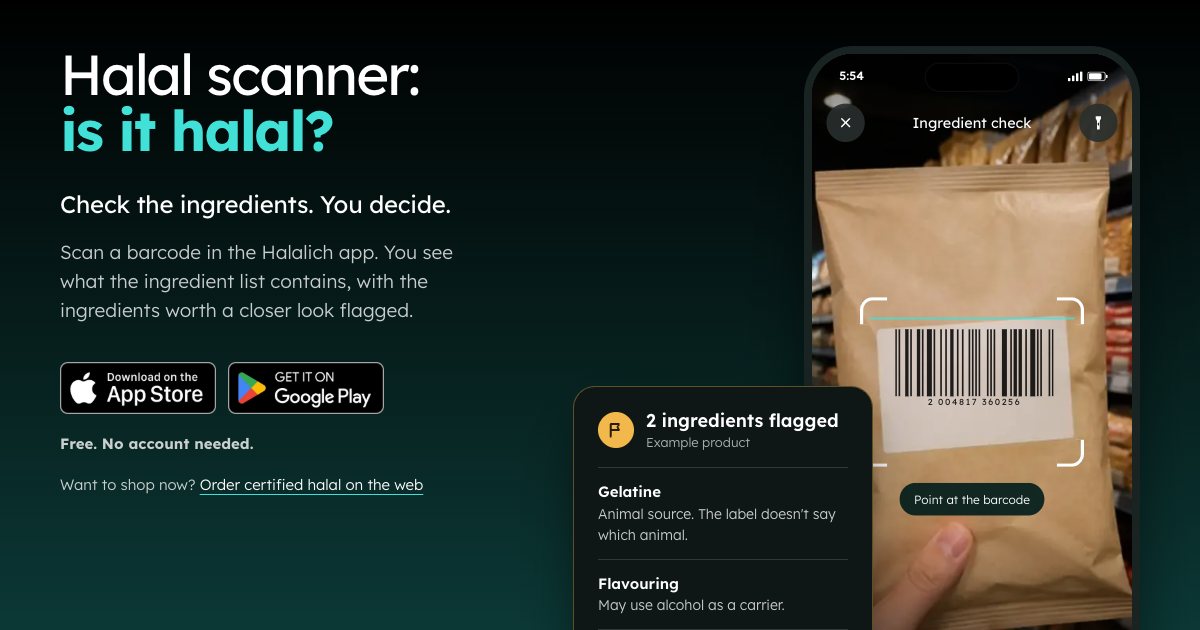
You do not need to learn this table by heart. The Halalich app has a free ingredient scanner. You do not need an account.
Scan a barcode, and the app shows which ingredients are worth checking and what to do next. It shows what the ingredient list says. You decide.
See how the Halal Scanner works
For more on certification and what it covers, read what halal certification means in Germany.
Browse the shops in the Halalich app for groceries that are already checked.